Tab Ramos
The first player to sign with MLS, a three-time World Cup veteran, and a National Soccer Hall of Famer.

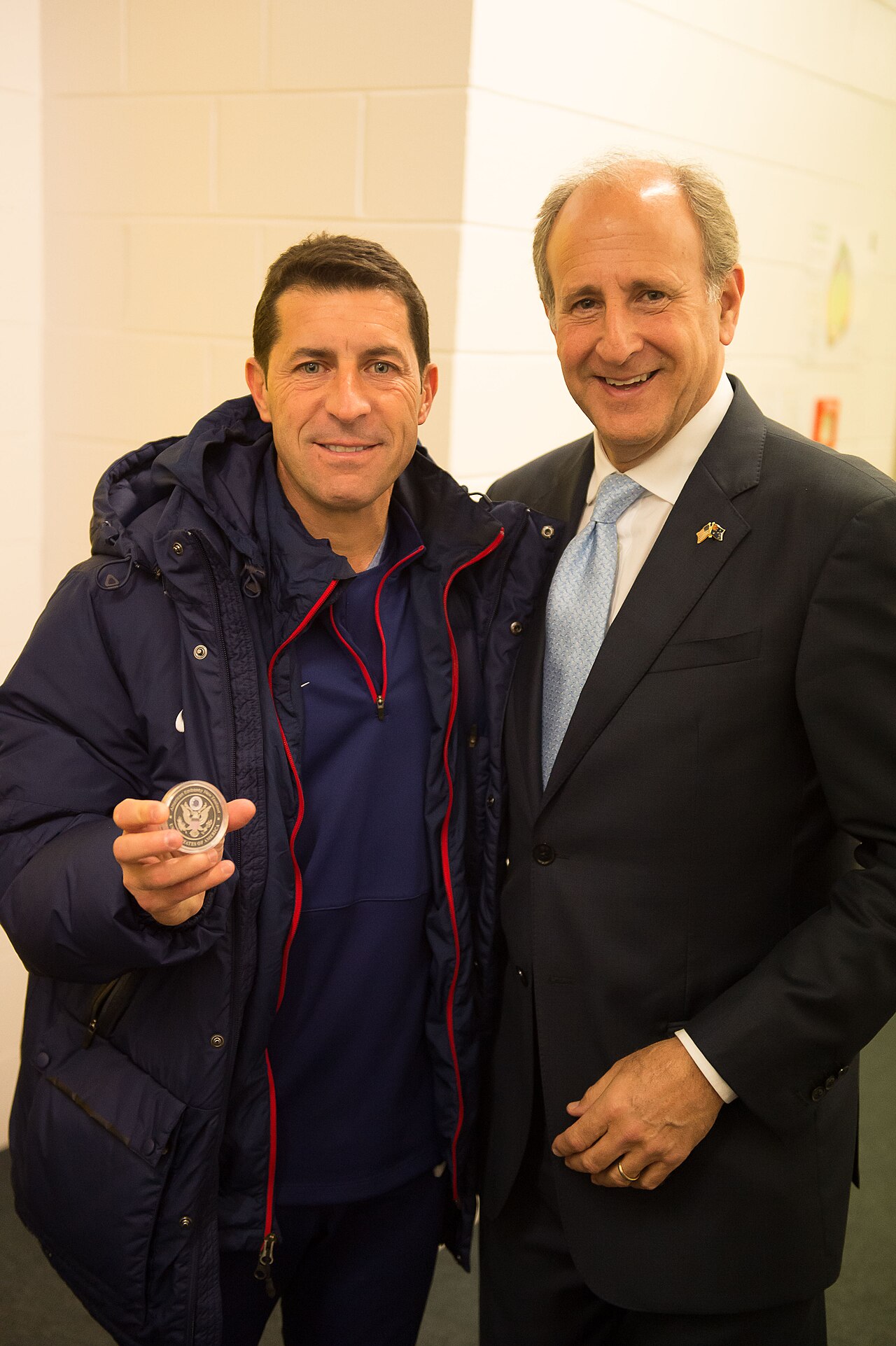
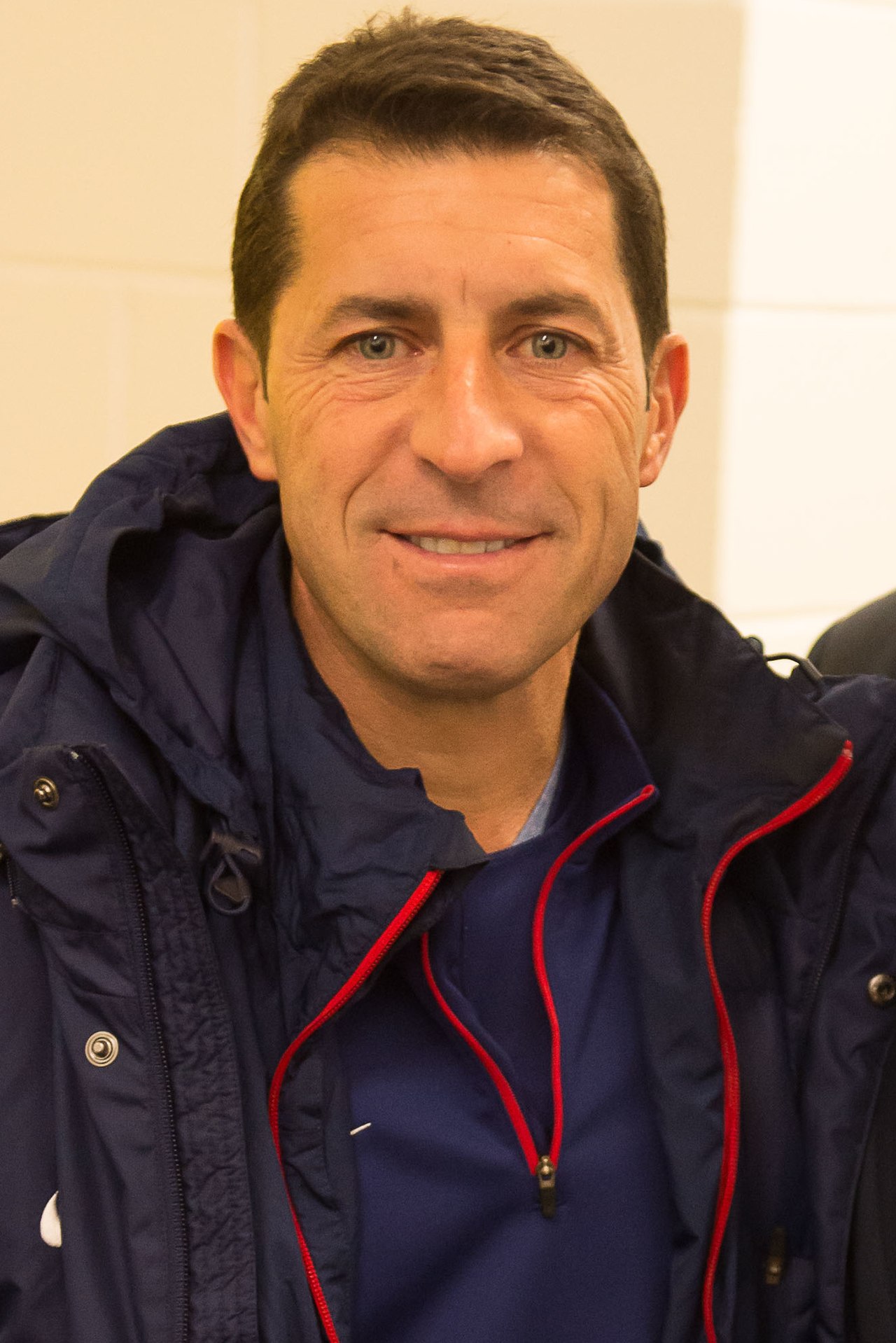
US Embassy from New Zealand · Public domain
Tabaré "Tab" Ramos Ricciardi (born September 21, 1966) is a soccer coach and former professional player who played as a midfielder. Born in Uruguay, he played for the United States national team. Over his thirteen-year professional career, Ramos played in Spain, Mexico, and the United States. The first player to sign with Major League Soccer, he spent the last seven years of his career with the MetroStars (now the New York Red Bulls). He featured in three World Cups and was elected to the National Soccer Hall of Fame in 2005.
- Position
- midfielder
- National Team
- United States
- Key Tournaments
- 1990 FIFA World Cup, 1994 FIFA World Cup, 1998 FIFA World Cup
- Notable Clubs
- Figueres, Real Betis, Tigres, MetroStars
- Status
- Retired
Verified Timeline
Lore & Background
Ramos began his national team career at the U-20 level in 1982, just after gaining his U.S. citizenship. He was 16-17 when he scored two goals in the regional qualifying for the 1983 FIFA U-20 World Cup. In 1984, Ramos was the last player cut from the U.S. 1984 Summer Olympics soccer team. He went on to play for the U.S. team at the 1988 Summer Olympics in Seoul, South Korea. Ramos earned his first senior cap on January 10, 1988, against Guatemala. After playing in the 1990 FIFA World Cup, he was named U.S. Soccer Athlete of the Year in 1990. In the 1994 World Cup round of 16, Ramos suffered a skull fracture caused by an elbow to the head by Brazilian leftback Leonardo, which resulted in a straight red for Leonardo. Ramos was in the hospital for several days where he was visited by Leonardo. He saw success in 1995 as a member of the U.S. team when it placed fourth at the Copa América. On September 7, 1997, Ramos scored against Costa Rica in a 1–0 World Cup qualifier win. He played in his third World Cup in 1998. Ramos made his last national team appearance on November 15, 2000, in a 4–0 U.S. win against Barbados. He finished his national team career with 81 caps and eight goals. Ramos also played 8 games, scoring 3 goals, for the U.S. Futsal team which finished 3rd at the 1989 FIFA Futsal World Championship.
In Their Own Story
In 1994, Ramos was chosen as the CONCACAF Player of the Year. That same year, in the World Cup round of 16 against Brazil, Ramos suffered a skull fracture from an elbow by Brazilian leftback Leonardo. The incident resulted in a straight red card for Leonardo. Ramos spent a few weeks in the hospital, where he was visited by Leonardo. Despite the injury, Ramos returned to play, and in 1995 he was part of the U.S. team that placed fourth at the Copa América. On September 7, 1997, he scored the only goal in a 1–0 World Cup qualifier win against Costa Rica. He played in his third World Cup in 1998, and made his final national team appearance on November 15, 2000, in a 4–0 win against Barbados.
Reader's Guide
Tab Ramos was a midfielder who played professionally in Spain, Mexico, and the United States. He was the first player to sign with Major League Soccer, joining the MetroStars in 1996. Over seven seasons with the MetroStars, he earned All Star recognition in 1996, 1998, and 1999. He totaled eight goals and 36 assists in MLS play (ten goals and 39 assists in all competitions). In Spain, he played for Figueres in the Second Division, where he played with Tito Vilanova, and later for Real Betis, winning promotion to La Liga in the 1993–1994 season. In Mexico, he played for Tigres, becoming the first American player to appear for the side, and helped the team win the 1996 Mexico Cup, its first title in 20 years. Ramos also played for the New Jersey Eagles and Miami Sharks in the American Soccer League. He was inducted into the National Soccer Hall of Fame in 2005.
Did You Know?
- Ramos was the first player to sign with Major League Soccer.
- He suffered a skull fracture from an elbow by Brazilian defender Leonardo during the 1994 World Cup round of 16.
- Ramos was elected to the National Soccer Hall of Fame in 2005.
- He played with future FC Barcelona manager Tito Vilanova at Figueres in Spain.
- Ramos still holds the New Jersey High School boys' soccer career scoring record of 161 goals.
From Montevideo to New Jersey: A Young Talent's Rise
Born in Uruguay on September 21, 1966, Tabaré "Tab" Ramos Ricciardi grew up in a household where soccer was a family tradition. His father had played professionally for CA River Plate, and that passion passed directly to the young Tab, who played for the Union Vecinal Youth Soccer Club in Montevideo before his family emigrated to the United States when he was just eleven. Settling in Harrison and Kearny, New Jersey, he enrolled at Saint Benedict's Preparatory School, where his talent quickly became undeniable. He earned two-time All-America honors, was named Parade Magazine's National High School Player of the Year in 1983, and led his team to the New Jersey State Championship. His career scoring record of 161 goals for New Jersey high school boys' soccer still stands, with 57 of those coming in his senior season alone. Beyond the pitch, he also competed in indoor track events including the 60-yard dash and the 4 × 100 meter relay. In 1984, the New York Cosmos selected him with the tenth overall pick in the NASL draft, but he opted for college instead — a decision that proved prescient when the league dissolved roughly six months later.
A Career Spanning Three Nations
Ramos's thirteen-year professional journey carried him through Spain, Mexico, and the United States. After a league All-Star season with the Miami Sharks, the U.S. Soccer Federation loaned him to Spanish Second Division club Figueres in 1990, where he featured in 38 matches and found the net five times before his contract was purchased for $250,000. A red-card ejection against Rayo Vallecano in November 1991 triggered a three-game suspension that cooled top-flight interest. He subsequently joined Real Betis for $400,000, helping the side win the Segunda División and secure promotion in 1993–94. On January 3, 1995, Ramos became the first player ever to sign with Major League Soccer. When the league's launch slipped a year, he was loaned to Tigres in Mexico, contributing to their 1996 Mexico Cup triumph — the club's first title in two decades. Returning home, he anchored the MetroStars for seven seasons, collecting All-Star honors in 1996, 1998, and 1999, and retired at the end of 2002 as the final original member of the squad.
National Team Legacy and Hall of Fame
Ramos's international career with the United States spanned three World Cups, cementing his place among the nation's most decorated soccer players. His journey on the global stage began at just fifteen, when he scored twice in regional qualifying for the 1983 FIFA U-20 World Cup shortly after becoming a U.S. citizen in 1982. He went on to represent the country at the 1983 Pan American Games and the 1988 Summer Olympics. His most defining moment came during the 1994 World Cup, where a collision with Brazil left him with a skull fracture — an injury that kept him out of La Liga the following season despite his Real Betis contract. That same year, he was named CONCACAF Player of the Year. His long-standing partnership with John Harkes, a friendship forged at the youth club Thistle FC in New Jersey and carried through every level of the national team, became a symbol of American soccer's golden generation. Both men were elected to the National Soccer Hall of Fame in 2005, a fitting capstone to a career that helped elevate the sport in the United States.
The Long Road to a Degree
Over four seasons of NCAA soccer, he earned All-ACC honors every year and was a three-time All-American. His senior campaign saw him tie Bruce Murray for the Atlantic Coast Conference scoring title. Yet his collegiate path was anything but linear. In 1988, he left campus to represent the U.S. at the Summer Olympics, and in 1989 he returned only to depart again when he committed to the national team full-time. Rather than abandoning his studies, Ramos persisted through years of correspondence courses, finally completing a Bachelor of Arts in Foreign Language (Spanish) and Literature in 2001 — a full thirteen years after his initial enrollment. This determination to finish what he started, even while competing at the highest levels of professional and international soccer, speaks to a work ethic that extended well beyond the pitch and defined his character throughout a career that spanned three countries and thirteen years.
Gallery
More in Players & Legends
Related in United States Mens National Team
Links follow this subject's own source article.
Elsewhere in the United States Mens National Team universe
Spotted an error? Know more?
This is a living reference — every entry is fact-audited, and reader corrections feed straight into our audit queue. Suggest an edit · See this site's audit record